Gas transmitter - ADOS LCTR 903
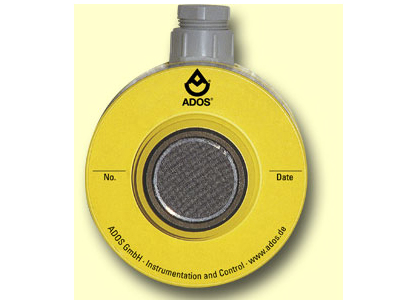
Two transmitter versions with different output signals are available:
- 3-wire 4–20 mA
- 4-wire LON? (LCTR 904)
Three measuring principles are available:
- VQ
- TGS
- IR
- 技術參數
- 產品特點
- 應用領域
- 資料下載
Technical data
|
The TGS sensor
The TGS sensor contains a semiconductor sensor,
which is constructed on SnO2 -sintered N-substrate.
When combustible or reducing gases are absorbed by the surface of the sensor, the concentration of the test gas is determined by the change in conductivity.

1 = Circuit voltage
2 = Heating voltage
3 = Load resistor
The VQ sensor
The head of the VQ sensor functions on the principle of heat reaction. When combustible or reducing gases or vapours come in contact with the measuring element, they are subjected to catalytic combustion, which causes a rise in temperature. This rise causes a change in the resistance of the measuring element which is used as a measure of the component of gas being tested. The inert element is for compensating the temperature and conductivity of the test gas.

1 = Catalyzer pellistor
2 = Electric connections
3 = Inert pellistor
4 = Diffusion filter
The test gas flows through a measurement chamber that incorporates an IR radiating source and a two-channel infrared detector. The intensity of the infrared radiation is reduced as it passes through the gas molecules. The concentration of the gas can then be calculated by the magnitude of the reduction in intensity. Since only absorption of the wavelength (A) specific to the gas under test in relation to the wavelength (B) not absorbed by a test gas is considered, interference due to dust, ageing etc., is almost fully compensated.

1 = Infrared-radiation source
2 = Test gas
3 = Diffusion filter
4 = Infrared-detector
5 = Measurement chamber
- Gas fired boiler systems
- Gas distribution station
- Gas transfer station
- Battery charging station
